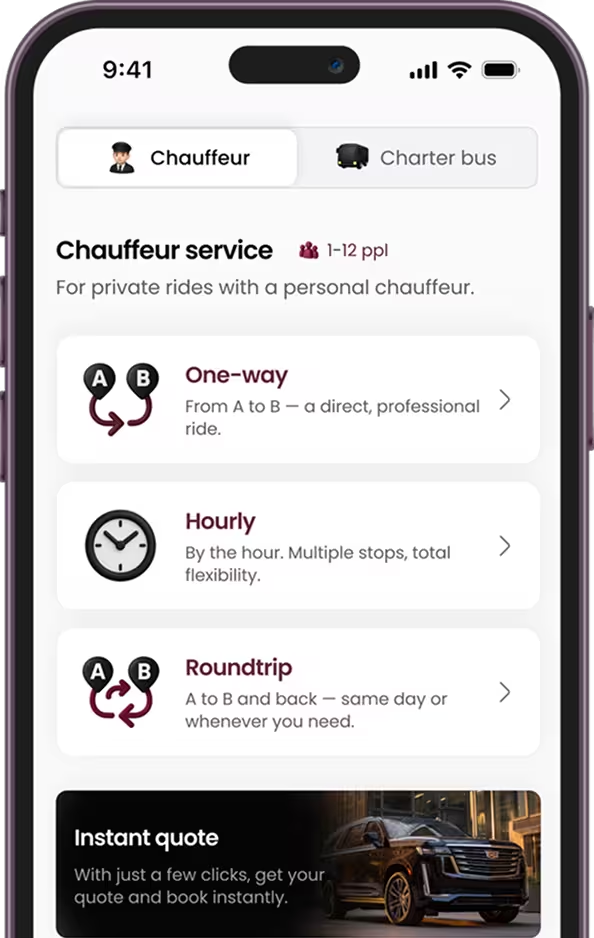
One-Way Service
Round-Trip Service
Hourly Service

Don’t Just Take Our Word for It
Hear what our clients are saying about their experience with Bookinglane.
Getting Around Germany
Business in Germany is spread over many cities, and each has its own fair or congress ground. Messe Frankfurt has more than 400,000 m² of hall space. On the right bank of the Rhine, in Deutz, lies the Koelnmesse, next to its own ICE station, and Messe München sits in Riem, in the east of Munich. Messe Berlin lies under the Funkturm in the west of the capital, and Messe Düsseldorf has 18 halls. Hanover's fairground, at about 392,000 m², is one of the largest in the world.
A one-way transfer fits a single appointment. For a day with several, book hourly service: you choose where it starts, where it ends and how many hours it lasts, and one chauffeur with one vehicle stays with you for that time. Assistants and travel managers who book for others can keep every journey in one account, each confirmed on its own.
Many German cities have a low-emission zone that is open only to vehicles with a green sticker. Berlin's lies inside the S-Bahn ring and Munich's inside the Mittlerer Ring; Cologne, Frankfurt and Wiesbaden have one too, and Stuttgart adds diesel driving bans. Hanover, Heidelberg and Mainz have lifted theirs. If your hotel or meeting lies in a restricted area, tell support before the trip and you will hear how close the vehicle can get.

Airport Transfers in Germany
Transfers run from Frankfurt Airport, Munich Airport, Berlin Brandenburg Airport, Düsseldorf Airport, Hamburg Airport, Stuttgart Airport, Cologne Bonn Airport, Hannover Airport, Nuremberg Airport, Leipzig/Halle Airport, Bremen Airport, Dortmund Airport, Münster Osnabrück Airport, Dresden Airport, Karlsruhe/Baden-Baden Airport, Paderborn Lippstadt Airport, Saarbrücken Airport, Erfurt–Weimar Airport and Rostock–Laage Airport.
Airport and destination sometimes lie in different countries. Frankfurt-Hahn is a separate airport 115 km west of Frankfurt Airport. Maastricht Aachen Airport is 40 km from Aachen, EuroAirport Basel Mulhouse Freiburg 74 km from Freiburg, Strasbourg Airport 99 km from Karlsruhe and Václav Havel Airport Prague 160 km from Dresden. A transfer booked to the final address covers the whole distance, border included.
On arrival the flight is followed, so a late landing moves the pickup. The booking confirmation names the vehicle, the meeting point and the time.
For the flight out you choose the pickup time. Plan by road time, not distance: 25 to 35 minutes from the centre of Frankfurt to Frankfurt Airport, 40 to 55 minutes from Munich to Munich Airport and 35 to 45 minutes from Berlin to Berlin Brandenburg Airport. In fair weeks and at rush hour allow more, plus your airline's check-in time.

Long-Distance and Cross-Border Trips
The longest regular runs connect the big cities. Frankfurt to Munich is about 390 km, Berlin to Hamburg 290 km, Munich to Stuttgart about 220 km, Frankfurt to Cologne 190 km and Berlin to Leipzig about 190 km. Hamburg to Hanover is about 150 km. Munich to Neuschwanstein Castle is 129 km. Book these one-way, with one chauffeur from address to address, or as a round trip with both pickup times set in advance.
Most intercity guests come by ICE. Frankfurt, Cologne, Munich, Nuremberg, Berlin and Hamburg are all linked by fast trains. Enter the train and its scheduled arrival time in the booking, and the pickup is set for that time.
Several neighbouring countries lie closer than the next German city. From Aachen it is 144 km to Brussels, from Freiburg 72 km to Basel, from Munich 145 km to Salzburg and 144 km to Innsbruck, and from Frankfurt 237 km to Luxembourg. Berlin is about 345 km from Prague. A journey that ends abroad is booked like one inside Germany.
Germany has notified checks along its land borders through 15 March 2027, and they can lengthen a trip abroad. Switzerland stays outside the EU customs union, so customs rules apply at its border. Take the travel documents your nationality and route call for.

Groups, Events and Custom Plans
A Sprinter van takes up to 12 passengers and a coach up to 56, so a board, a stand crew or a school party can travel as one group. At trade fairs the load matters as much as the headcount: sample cases, display material and laptops need room, and so do the bike boxes and golf bags of leisure groups.
Larger programmes follow the calendar. Carnival in Cologne in February, ITB in Berlin (16–18 March 2027), gamescom in August and the Oktoberfest in Munich, which runs from September into early October, all commit local vehicles early, and so do the Christmas markets from late November. The Hannover Messe runs 5–8 April 2027 with about 3,000 exhibitors, MEDICA in Düsseldorf 15–18 November 2027, and the Cranger Kirmes in Herne, with about 4 million visitors, 5–15 August 2027. The Frankfurt Book Fair returns on 6–10 October 2027; in 2025 it had 238,000 visitors and 4,350 exhibitors. On the busiest dates, separate booking rules apply.
For a group, an event or anything beyond a single booking, contact support before you book and send the dates, every address, the number of passengers, the flights and the luggage. Vehicles and pickups are then planned as one programme.

Luxury Rides. Executive Comfort.
Unmatched Experience
Premium transportation for those who value time, privacy, and sophistication.
Every ride is designed around your needs — because every mile should make a statement.

Premium Sedan – Business Class on Wheels
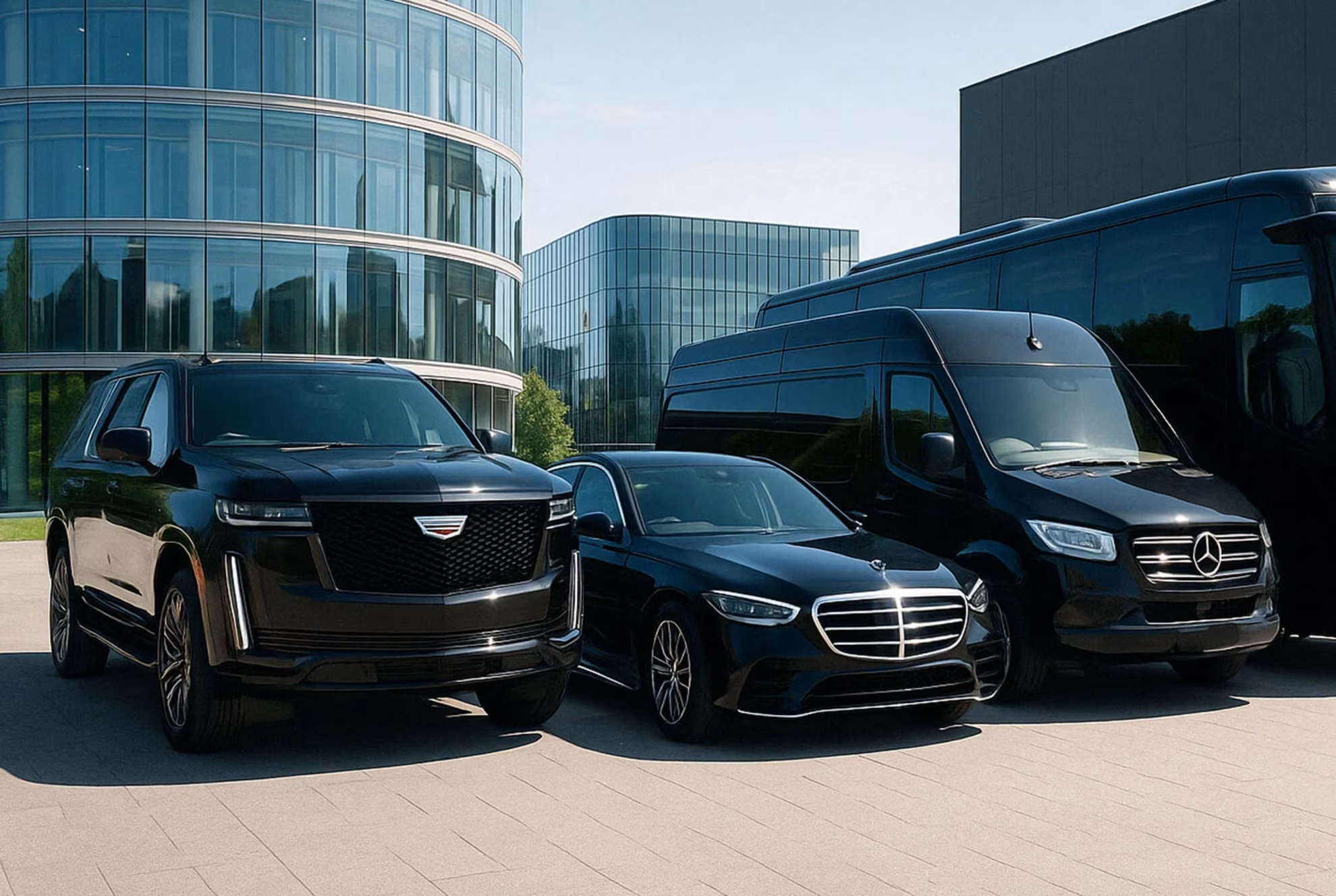
Ideal for solo travelers or up to 2 passengers seeking discreet, comfortable transport. Ride in a Mercedes E-Class, Volvo S90, Cadillac CT6, or a similar executive-class sedan — perfect for airport pickups, meetings, and city rides in style.

Premium SUV – Travel Together, Arrive in Style
Spacious, powerful, and refined. Our Premium SUV service is perfect for groups of up to 6 passengers. Ride in a Cadillac Escalade, Chevy Suburban, or GMC Yukon — ideal for corporate teams, families, or VIP guests who value both space and elegance.

First Class Sedan & SUV – Executive Luxury, Refined
When only the best will do. Our First Class Sedans and SUVs deliver elevated comfort and prestige for up to 6 passengers. Travel in premium vehicles such as the Mercedes-Benz S-Class, BMW 7 Series, or Cadillac Escalade, designed for executives, VIP guests, and high-profile arrivals where comfort, discretion, and style matter most.

Sprinter Van – Group Travel, Reimagined
Travel together without compromise. Seats up to 14 passengers with space for luggage and premium comfort. Mercedes Sprinter, Ford Transit, or similar — ideal for corporate rides, airport transfers, and events.
Explore our premier car service in the following cities:
Let’s Grow Together — Partner With Bookinglane
Tailored programs for businesses, agencies, and creators — built to serve your goals.

Corporations & Enterprises
Corporate travel, simplified
Easily manage team transportation — from daily office shuttles to VIP transfers.

Travel agents & Event planners
Scale your business with our tools
Fast, flexible bookings for your clients — with full API access and dedicated support.

Influencers & Public figures
Collaborate with Bookinglane
Travel in style, share the experience, and earn with every ride you inspire.
Frequently Asked Questions
Everything you need to know before booking your car service with Bookinglane.